Wednesday, May 15, 2013

Thinking about Population Density


We had already plotted out our game board territory and had just finished counting our populations. The population count was posted on our game board and we were seeing the numbers for the first time all together. Here are pieces of the conversation.

Mason: It is sort of like the real world because Giovanni has this big piece of land and 42 people. Aliza has 1 square but she has more people than Giovanni.

Teacher: More people live in that one square than in that whole green country. How will it impact their lives and their cultures?

Ellie: I have a question. Is the population going to affect how many people immigrate from our country?

Teacher: That is something we need to think about.

Aliza: It might matter because like in China, if there are too many people, they might want to move.

Teacher: If you are in Aliza’s country and there are 71 people squished into that tiny square, do you think they might be anxious to get out to where they could have more land?

Teacher: We should figure out how many people per square so that we can compare them.

Giovanni: Joe’s country will have a really big immigration rate. They will feel really squished. There might be a lot more people immigrating from Joe’s place because they are squished.

Kali: I think the population does matter. He [Joe] has tons of spots and tons of people, but they are also squished among other countries that have tons of people, mine and Mason's. Our countries are practically hugging each other. They are surrounding each other. And they have got millions of squished people. You want to move. You want to get out of there. There are places like Giovanni’s where they might have too much room and people start to feel too free.

Giovanni: I don’t think that it is possible to feel too free.

Kali: They have too much room so they want to move somewhere else.

Rose: Population does matter. If you have a huge country and one person in it (haha) that person would just be like “Hi?.... Hello??”

Teacher: So if there is not enough population people might feel isolated and lonely?.

Max: The population would matter because in Aliza’s country, there wouldn’t really be room for an airport. The air plane would be running over people.

Teacher: I also think about them having to have really tall buildings.

Rose: Like China!!
Max: The other thing is, see in a lot of these countries. Kirby has 142 and Aliza only has 71. Aliza still kind of has more

Teacher: More PER…

Max: More density because even though Kirby has about double… no, exactly double, but she will have a lesser density because her land is much bigger than Aliza’s.

Emeline: I don’t think it really matters because we are doing a game about mixing cultures. I think it is getting off track.

Teacher: I think it will affect your culture.

Giovanni: I think the population vs land does matter. Joe has the most people and the most land. Joe’s country won’t have much need to technology. Aliza’s country will need a lot of technology. She will probably need airplanes that take off from sky scrapers.


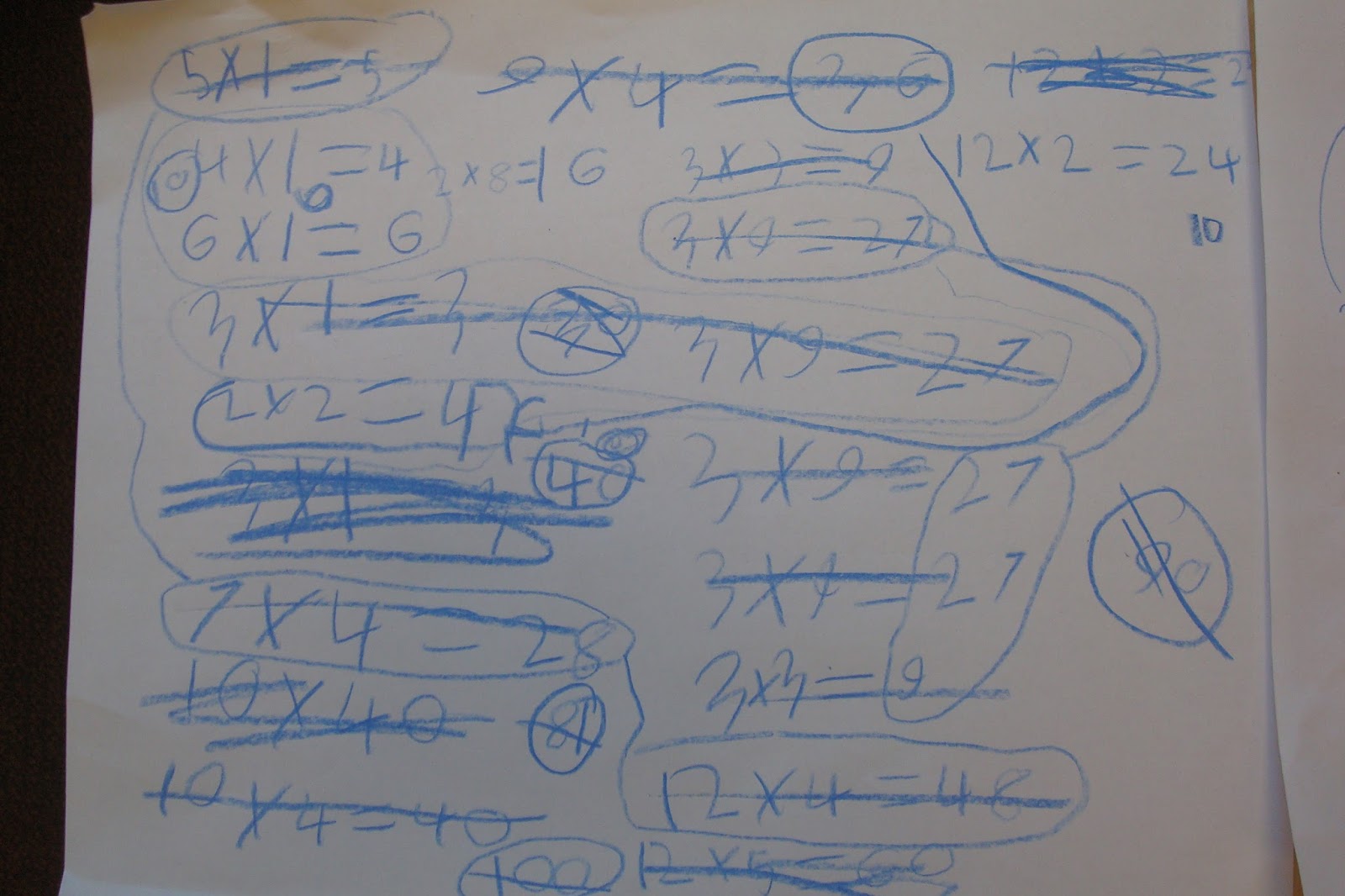
So, we set out to calculate our population density. It is fairly straightforward until you have left over people that need to be split evenly among the squares of land. There was a variety of methods. Here are a few (quite beautiful, if you ask me!). The children worked for nearly 2 hours. Students who had figured out a good strategy for dividing the left over people made their way around the room to help support their friends.


"We have 24 5/8 in each pile, we took about an hour to figure it out. This is the final way I did it , but I did two other ways that were NOT right! We made 8 towers (one for each square of land) and added 2 people to each tower until we had 24 people. We had a few extra people, not enough for each tower to get one more, so Kirby found out it would be 5/8. She knew I had 8 squares of land and we have five people left. So she divided the five squares into eighths and gave 1/8 to each square. She did it again until she had given away all five people making the final answer 24 5/8."


Habits of mind this child identified using:
Persisting
Creating, imagining and innovating
Taking responsible risks
Thinking interdependently
Finding humor
Thinking flexibly
Striving for accuracy
Listening with understanding
Remaining open to continuous learning
Managing impulsivity
Questioning
 

Detours Are the Learning

When I was young, we often took family road trips. My whole family squished into our van and headed for some destination. Inevitably, my dad would pull over at some historic detour so that we could read the plaques and see the sights. I remember thinking, "Why can't we just be a normal family who rents jet skis or goes to amusement parks for family vacation?" We were always stuck with this history stuff. And then last summer, when I was with all of my siblings again, WE were the ones that wanted to go to all of the quirky little historical spots and read the plaques. All of these detours shaped us into curious people and helped us build a sense of ourselves as part of something much bigger. We came to see that the spirit of road-tripping is the detours. Finding yourself in some unexpected place, being introduced to some American oddity one didn't know existed is the most compelling piece of the experience.

I think about my childhood road trip detours during our project work at school. Our approach to learning is often organic and meandering. We find LOTS of detours. The detours aren't separate from our learning, they just seem like they take a long time. We're trying to create a culture mixing game and it feels like it is taking FOR-EV-ERRRRR, but that is because we are taking time on some of our detours to examine things like how population density affects cultures and how location on the globe impacts one's climate (and because we have things we're trying to finish before the end of the year.... and because we're in the middle of our end-of-year testing, but you know what I mean).

Eventually I figured out that detours were the road trip. I'm being reminded of that in our project work. Even if our game were never to be completed, all of the thinking and conversations along the way about cultures mixing, what happens with different generations of immigrant families, what factors helps shapes one's culture, how we are all the same in that we are a mix of cultures but that no one quite has our exact recipe, or how having the highest population density may be a catalyst for more emigration out of one's country. In the end, these detours are the learning.

Wednesday, May 8, 2013

Totally Worth It!


This morning I was sitting in a room full of children busily building polyhedra. There were straws and twisty-ties EVERYWHERE! But people were engaged and excitedly talking about what happens when you squish a cube or what a twelve-sided polyhedron is called or if there can be a polyhedron with exactly three faces.  
 
Meanwhile a conversation started between students about how much they liked this kind of math. "At my old school we had to sit at our desk and do stacks of math worksheets!"
"Yeah, Sabot lets you have some creativity while you work."
The conversation went on an on. I was half listening as I called people over to demonstrate their understanding of these 3-D shapes by building a shape from clues about attributes.
"Build a shape that has exactly 5 vertices."
 
Later, we had to postpone snack (never a very welcomed change to the schedule) because it took so long to clean up. We ran out of time before P.E. I made a side comment about how doing these fun things took a lot more time to clean up and that we had to be flexible if we wanted to do things like this. On the way out the door one child said, "Well it is TOTALLY worth it!"
 
All in all, I just really appreciated the recognition the children had that they were being allowed to know and learn beyond making marks on paper. They were working with 3-D shapes as they were intended to be known-- in 3-D! It might be messier and it might now always translate to a multiple-choice test, but it is the kind of learning I value.


On another day, the children worked to produce designs that were
half-yellow as part of our study of fraction.
The children worked to develop systems of checking themselves.
How did they know their shape really was half yellow?
 In our checking, we often found errors and were eager to make
adjustments to have EXACTLY half yellow.


Friday, May 3, 2013

The Culture Game

Our school is hosting The World Peace Game this summer!

I've heard a lot of discussion about it lately as some of the children in my class are going through the registration process. I think the game is on our minds because our history investigation is developing in the path of a game, The Culture Game.

The inspiration for our game came from Parent Night.


Kali: They made green children because they were multi-cultural and they had two different cultures, not just one because if the orange culture is its own culture and the blue culture is its own culture, then they are technically making a new culture when you make it green.

Max: Then if even one orange person came over here, there could be hundred of green people because if more orange people come, then maybe one of these orange people could marry another blue person. We would end up getting a bunch of different cultures that you didn’t even have in the first place if just a few people didn’t immigrate. And it all started with just a few people immigrating here.
 
This conversation got us thinking about new cultures that develop as a mix of other cultures and wanted to think with color to represent the morphing of cultures as they mix.
How many colors would develop in America?
We each got a color of clay and made tiny ball people. We planned to mix them.
Wondering how to proceed with some sense of order and knowing the children had been thinking about creating a game to help them think and share about immigration, I saw an opportunity to slow down."We can mix our colors now (I think it will probably be over in about ten minutes) or we could slow down and turn this into the game you've been wanting to make. I think we would learn more."
While they were anxious to mix the clay, they were also willing to delay the immediate desire to make way for a slower, more deliberate process.
The initial set up-- just before we decided to slow down.
The children have been developing cultures for their people.
They thought of so many different things that could influence a group of people and their values and traditions.
  • Language
  • Values
  • Likes/dislikes
  • Talents of the country
  • Celebrations
  • Resources*
  • Pollution Rate*
  • Hemisphere
  • Climate temperature*
  • Water level*
  • Water purity*
  • Technology/modernization*
  • Type of ruler*
  • Ruler's Disposition*
  • Traditional Food
  • Music
  • Legends
  •  Vulnerabilities*
 *= were drawn at random out of a bag

Our current map.
A roll of the die determined the number of squares a country would inhabit.
How would the land size and the population work together to form the culture?
 Placement on the map was determined by the hemisphere
 and the temperature of the country's climate. Hot countries were placed near the equator
and cold countries were placed near the poles.

 
We are trying to determine how to proceed. How will we take turns? How many people will immigrate? How will the cultures mix? How do we keep track of the changing cultures?
 
We shall see what the future holds...


Looking Through The Lens: Habits of Mind


We revisited the Science Handbook that we wrote earlier in the year,
but this time we looked through the lens of the Habits of Mind
 
We found the most of the sections in our book matched at least one Habit of Mind.
It was exciting to see that the characteristics of successful people were so closely
related to the skills the children identified themselves doing
as successful scientists researching shadows.


While the children learned a great deal about shadows,
 there will always be more to know.
These habits are the learning that lasts.
 It is the learning that will carry them forward through their next challenges.


Our Guidebook Section                                          Correlating Habit of Mind

* Using our sense to observe                                *Gathering data through all of the senses

*Making connections                                            *Applying past knowledge to new situations

*Try, try again                                                       *Persistence

*Be willing to change your mind                          * Remaining open to continuous Learning
based on what you observe        

*Think outside the box                                         *Creating, imagining and innovating


Tuesday, April 30, 2013

Community Sculpture


During the first few weeks of school, we set the intention of creating a sculpture that would hang right inside our door. It would serve as a reminder of the type of community we are working to be. We just recently finished it, months later (it is a bit hard to photograph). Working on it slowly over time helped us to revisit the ideas each week. Each of the items was carefully chosen to represent a characteristic that is vital to a supportive community. Here are the children’s thoughts on some of the symbols.


“The trophy means everyone is special because we could all get a trophy for something.”

“Mammoths protect their young. It reminds us to protect each other.”

“The sun is happy.”

“The moon is calm.”

“The Cloud Dragon drops rain on fire. The fire represents rage or revenge. The dragon is a peacemaker.”

“The sword means protect someone in need.”

“Bees work together to make honey.  The beehive means work together.”

“The ladder is climbing up to the peace sign. It means that we need to keep striving for peace.”

“Peregrine falcons are clever, fast and work together. A big group of people working together gets the job done fast.”

“The skull reminds us that the Native Americans used every part of an animal’s body. We need to use our resources well and not waste things.”

Friday, April 26, 2013

Forest Data

We've worked hard all year to observe the creek and collect data.
The time has come to start representing.
 
The experience is helping provide valuable lessons as the children think
about what is going well and what they wish they had considered along the way.

"I have the same date twice on my page! I don't know which one is right."
"I have 1 degree on here and I know that cannot be right."
"I lost my recordings for a few weeks."

These are the lessons that young scientists can only truly learn from experiencing it.
Adults can remind the children a thousand times to bring a certain tool
or keep track of data, but the children only begin to care from
an authentic place of wishing they had _________."

Soon we will look at all of our data so see what we notice.

We had visitors tour our school last week as part of our Personal Pathways and Paradigms institute here at Sabot. As the guests toured, we worked to answer the question "How has America's story of immigration impacted you and helped make you who you are?" Here are a few peeks at the children's thinking and representations.


These cups represent a happy life full of good things and a life full of darkness and struggle. The child who made this said that at first they thought their life was like the dark cup. As they started hearing the stories of immigrants, they realized there was more good in their own life than the child had realized. Hearing the struggles of generations of the past, gave the child a new lens for their own life and challenge. It has helped to reframe the child's own experiences.

“When I studied immigration I realized that we are lucky to have what we have because there are people who don’t have what we have.”

 How does our study of immigration bring a fresh perspective to our own lives?


"This ball of wire represents a person who is an immigrant.
The purple gem inside is their heart full of a desire to start a new generation.
The propeller represents determination.
The wooden tubes with colors shooting out represent flairs.
They symbolize happiness when they finally make it to America.
The dark veil is like darkness and fright. It covers the whole journey.
The green glass piece at the end is the new generation that came out of this journey."

 "The point of this collage is that without the determination of our ancestors, we wouldn’t be here. The thing that really sent them forward was the thought of future generations."

 In response to this work, another student commented, "I don’t know if you mean it, but the flairs of joy are holding up the veil of darkness and making it possible for the immigrant to pass through. It is making the journey possible.”

 Another child said, “Our ancestors probably wondered if we would remember them and their sacrifices.”

Did our ancestors think of us during their journeys?            

Did past ancestors think of future generations?

Friday, April 12, 2013

Shadow Book


ShadowBookMovie from Andrea Pierotti on Vimeo.


While preparing for our school institute next week, I made our class shadow book into a video format for presenting purposes. This format makes it easier to share on the blog, too. I though some of you might like to see it in more detail.

Inspired by A Drop of Water by Walter Wick, this third grade class created beautiful photographs to communicate the simple but profound things they learned about shadows during their science investigation. The pictures and words were designed to share their learning as simply as possible. They prove that there is a lot more to know about shadows than one might initially think.

Photos and words by the 3rd Grade Children

Processing Through Symbols

We've been experimenting with using symbols to help process our reading. In our book groups, we read a chapter at a time and then work to develop a symbol that represents the essence of the character's experience in that chapter. I'm finding the needing to create a symbol brings new discussion to the groups. They talk longer and in more depth than they did before we started recording our thinking in this way. Here are a few examples from our reading today.
 
 In the book The Jade Dragon, the main character Ginny finally connects with Stephanie when the two confide the struggles and secret wishes of their hearts. Ginny has been wanting to be best friends with Stephanie for a while, but has been hunting for common ground. It was this opening up and being vulnerable that finally connected the two. Each was feeling like a fish out of water, feeling different from the children around them. Only when they had the courage to confide, did the two make a meaningful connection.

Ginny had tried for so long before this. What was it that had finally connected the girls?  This is a symbol the children created. They realized that sharing the secrets was what welded Ginny and Stephanie together.


In the book Lily's Crossing, Lily is going through a lot of challenges. Her father went to war, her best friend moved, she has developed a habit of telling little white lies to get attention. In the chapter the children read today, Lily was processing all of her difficult feelings.

This is the symbol some of them created. It is Lily pulling a wagon full of heavy boxes. The boxes represent all of the emotional situation in her life. Up to this point, Lily was managing to pull the wagon. In this chapter, the wagon stops suddenly and all of the boxes come tumbling down. Lily can ignore them no longer and must face her emotions.


In Drita My Homegirl, Maxie is dealing with the loss of her mother to a car accident. Her dad is finally ready to start dating again which stirs up all kinds of emotions within Maxie.

The symbols created by the group are a volcano to represent when Maxie was letting her emotions out in harmful ways by being mean, fighting with her family, being rude to her dad's girlfriend and repeatedly getting into trouble at school.

In a later chapter, Maxie is finally ready to be honest with her father. They have an important conversation about all that they are both feeling. The children represented this chapter with a calm waterfall to show that Maxie is now releasing her emotions in a productive and less harmful way.


Using symbols to represent our reading is something I'm going to stick with. The level of sophistication and collaboration I've seen and heard is deepening.  The children sketch and talk and suggest modifications they feel would more accurately portray the emotional journey of their characters. They are also more eager to participate in the group conversations because they are proud of their symbols and anxious to tell others about their representations. Yay!!!

Friday, April 5, 2013

Parent Night

Parents visited the classroom this past Wednesday. We talked about thinking symbolically and the power of the metaphor to facilitate higher level thinking. Then the parents got to do some of their own work.

"Think about the emotional journey of an immigrant, the journey of the heart. How can you represent all or part of the journey symbolically?"

The children came back to school the next day to discover the parents' creations. We spend time thinking and discussing the representations. Actually, we spend a whole hour looking at them and talking about them. It is more than one blog can manage, so here are a few.


Kali: They made green children because they were multi cultural and they had two different cultures, not just one because if the orange culture is its own culture and the blue culture is its own culture, then they are technically making a new culture when you make it green.
Max: Then if even one orange person came over here, there could be hundred of green people because I more orange people come then maybe one of these orange people could marry another blue person. We Would end up getting a bunch of different cultures that you didn’t even have in the first place if just a few people didn’t immigrate. And it all started with just a few people immigrating here.


Cameron: The leaves, I like how she used the leaves because if you are like on a sail boat trying to seek freedom …. when the leaves fall from the tree, the wind could blow them away. Just like if a sail ship is crossing the ocean for a certain destination, the wind could blow them away. For example, the Mayflower was actually attempting to land in Jamestown.
Andrea: Sometimes you may end up where you weren’t intending.
Henry: When a leaf falls, I think that means when one leaf falls, leaves kind of spread. The first leaf starts all of the others. I think that means that if only one or two people land in a place that no one else has been before, they can make a whole settlement and make a civilization.


Henry: What happens if someone falls down the tree? It is like climbing the tree to Ellis Island but when they get there, someone says, “No, you can’t come!” so they fall back down the tree. I picture this never-ending tree with tons of paths and ways and what I think he means by perspective is that you can look down as past images of your life.
Aliza: I feel like once you get here [pointing to the three colored paddles in the middle of the tree] you have to choose which path to take.
Joe: When you get to the middle maybe you don’t have a job but you have friends and you have a nice place to live. Even though you really want a job, you still feel like you want to stay.
Andrea: You perspective changes along the way?
Mason: What happens when you get to the top of the tree? Do you get back down?
Henry: I keep picturing a never ending tree, like it keeps growing as you grow. I picture that the tree is your life… like your fortune or something.


Rose: I think it is really interesting. I feel like the blue panel is when they just see them, the red panel is when they are transitioning and the yellow panel is like, “Hey we can see her clearer now!

Henry: I’m not sure if the panels have to go in order. Everyone has a different perspective. Like what if someone sees them like this [put the blue panel on] and someone else sees them like this [puts the red panel on] and someone else sees them like this [puts the yellow panel on].

Andrea: So you are saying that rather than this person having different panels throughout, the people looking have the different panels? Someone sees everything with the red panel. Someone else looks through the yellow…?

Kali: I was thinking that maybe the blue panel meant, “I don’t really know this person.” The yellow means, “ Oh, we’re friends.” And the red is like, “ I hate you!”

Andrea: So maybe the different panels represent different emotions? Maybe one of them would be a prejudice.

Max: What I kind of thought was that you could have cross panels. You could have purple [puts the red and blue together] . It gets really dark. Then he almost becomes invisible to you.  It is not going to help you, so you want to kind of try to take the panel away from your eye. You want to tug it off.

Friday, March 22, 2013

They're Coming to America

We were inspired by a great poet this week. He wrote a moving poem about immigration, maybe you know it. Here are our class notes so far about Neil Diamond's poem "America". It inspired our own poetry writing (and maybe a spontaneous dance party or two, once I told them it was also a song).
 

Researching as Historical Authors

We've been researching. It is always easier with a lens. We've been wondering if the adventures of history could become the inspiration for fictional stories. Can we write historical fiction about our heritage of immigration? We currently look at many things through that lens.

A father, who immigrated from Honk Kong, came to visit us this week. He shared his story. We took time afterwards to compile a list of things from his experience that we could give to a character in a story we may write in the future.
  • He went to a party and didn't know what a taco was or how to eat it. Tacos seems exotic. He bites the middle and it falls apart. He watches everyone else to learn how to eat a taco. What exotic things will our characters encounter?

  • Missing the fresh food from home and not liking the American stuff from the market (open a box, open a bag, put it in the microwave). What about America might make our character miss home?

  • Liking how big and open America feels, the fresh air, the high standard of living and it does not feel  crowded. What might be different from home in a good way?

  • He keep some holidays from his old culture and also starts celebrating some from the new. What might our characters keep from their old culture and what might they acquire from their new culture?

We read an article about Ellis Island and took notes about experiences those passing through Ellis Island faced. Which experience might we give to our characters? We learned what steerage meant and what conditions might be like for passengers traveling in steerage. We know that they used phrases like "The Island of Hope" and watched carefully for the Statue of Liberty. Our characters probably will, too.


Thursday, March 7, 2013

Aliens Among Us


When we started to think about immigration, we realized that we knew people from other countries. In fact, we counted at least six who work right here on campus. We wrote to invite them to class. We've been listening to their stories for the past few weeks. They've talked about their motivations for coming to America, what they felt as they left home, confusing situations they found themselves in and what tokens they brought to remember home.

Meanwhile, we have also been considering under what circumstances we would be willing to leave our home forever. So far we have about 22 reasons that are compelling enough to the children. Interestingly enough, many of them are the situations our ancestors faced when deciding to immigrate.


Wednesday, February 27, 2013

MLK Day Lives On

Life's most persistent and urgent question is, 'What are you doing for others?'

Martin Luther King
 
 
At the food pantry

Getting organized
 

Filling bags
 
When we got back to school, we made posters that added to the message from Dr. King.
What advice did the children have?
 
"Helping makes everyone happy. When you help, you feel good too."
"Everybody is human."
"It is hard to be happy without being kind."